|
Stephanie's Homepage
|
Level 3
Here are the level 3 processing scripts run by Sebastian Panknin at DESY.
Cut variables
The level 3 cut varibles for IC40 are as follows:
- log10(AtmCscdEnergyReco_Energy) > 4.0
This cut is the high energy branch cut and does not require any other cuts to reach acceptable background rejection.
- log10(AtmCscdEnergyReco_Energy) < 4.0
- SPEFitSingle_Zenith × 180°/&pi > 80°
- CascadeLlhVertexFit_reducedLlh < 10
These cuts are the low energy branch cuts. All three cuts are required to reach an acceptable level of background rejection.
Reconstructions
The level 3 reconstructions for IC40 are as follows:
- AtmCscdEnergyReco
- SPEFit_32iter
- CredoFit
- FillRatio
- Split CascadeFirst
- Split LineFit
- Split TrackLlhFit
- Split CascadeLlhFit
Development of cuts
Below the development of level 3 cut variables is outlined. Experimental data is shown in black. Single, double and triple muon background CORSIKA are shown by the blue lines, combined CORSIKA is shown in red. Atmospheric signal is shown in green and the E-2 signal is shown in pink.
Figure 1 is the histogram of cascade energy reconstruction. This histogram shows the energy division that is used for the high and low energy branches of the level 3 cuts. This energy division is at log10(AtmCscdEnergyReco_Energy) = 4.0 and is shown as a black verticle line.
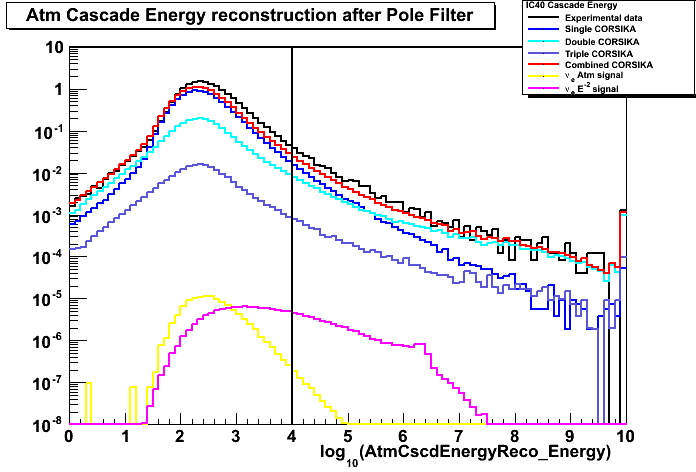 |
Figure 1: Reconstructed energy using Atmospheric Cascade Energy Reconstruction. The energy division is shown at log10(AtmCscdEnergyReco_Energy) = 4.0 in black.
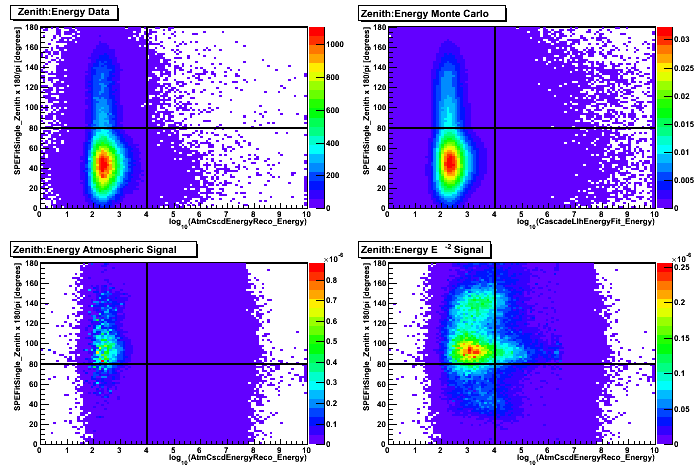
Above this energy division the background rejection is sufficient enough not to require any further cuts. Below this energy division further cuts are required to reach a sufficient level of backround rejection. Figure 2 shows scatter plots of the reconstruction zenith angle vs. the reconstruction energy. These histgrams show that a good criteria for cuts are log10(AtmCscdEnergyReco_Energy) < 4.0 and SPEFitSingle_Zenith × 180°/&pi > 80° and these cuts are shown in black lines.
One further cut is required to reach a sufficient background rejection. Figure 3 shows the next cut which is on CascadeLlhVertexFit_reducedLlh < 10 and this cut is shown by the black verticle line.
 |
 |
Figure 2: Scatter plots of zenith vs. energy. The cuts are shown in black at SPEFitSingle_Zenith × 180°/&pi > 80° and log10(AtmCscdEnergyReco_Energy) < 4.0. The bottom left area is the region that is rejected. a) Experimental data. b) Monte Carlo combined CORSIKA. c) Atmospheric signal. d) E-2 signal. Figure 3: Reduced log likelihood (LLH) reconstruction after energy and zenith cuts. The reduced LLH cut is shown at CascadeLlhVertexFit_reducedLlh < 10 in black.
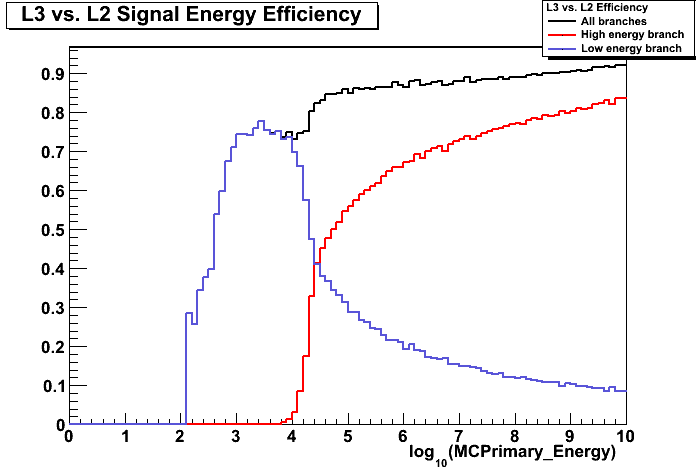
Figure 4 shows the energy efficiency for signal and Monte Carlo background when both the high energy branch and low energy branch cuts are combined.
 |
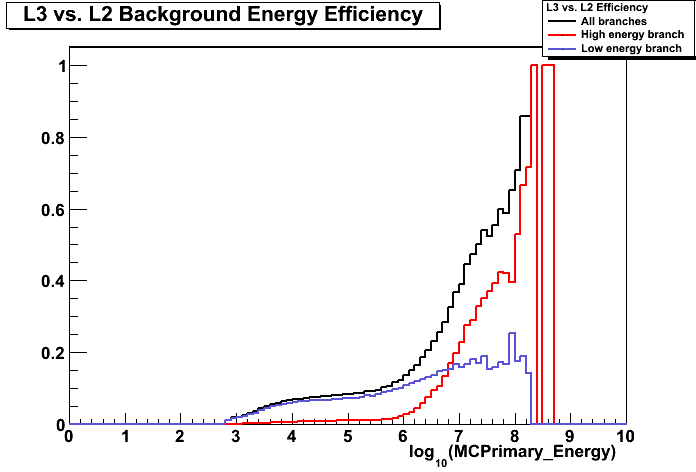 |
Figure 4: Signal efficiency for level 3 cuts. Figure 5: Background efficiency for level 3 cuts.
The overall (high energy and low energy branches combined) survival rates for data, Monte Carlo and signal are shown in Table 1:
| . | Trigger Rate (Hz) | Level 2 Rate (Hz) | Level 3 Rate (Hz) |
| Experimental data | 1500 | 16.3 (1.1%) | 1.75 (10.7%) |
| Monte Carlo | 1270 | 12.5 (1.0%) | 0.92 (7.4%) |
| Atmospheric signal | 1.33 × 10⁻³ | 1.15 × 10⁻⁴ (8.6%) | 7.18 × 10⁻⁵ (62.4%) |
| E-2 signal | 2.55 × 10⁻⁴ | 1.48 × 10⁻⁴ (58.0%) | 1.15 × 10⁻⁴ (77.9%) |
Table 1: Passing rates for level 3 cuts.
|