|
Stephanie's Homepage
|
Level 4
Here are my level 4 processing scripts run by me on npx3 at Madison.
Cut variables
Level 4 cut variables for IC40 are as follows:
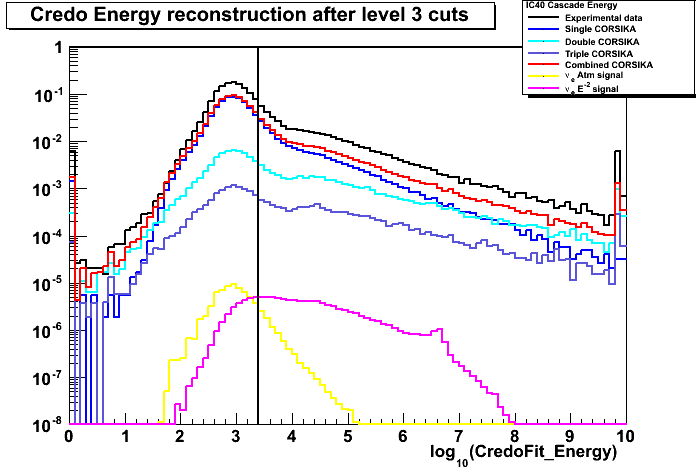
- Energy: log10(CredoFit_Energy) > 3.4 (2.5 TeV)
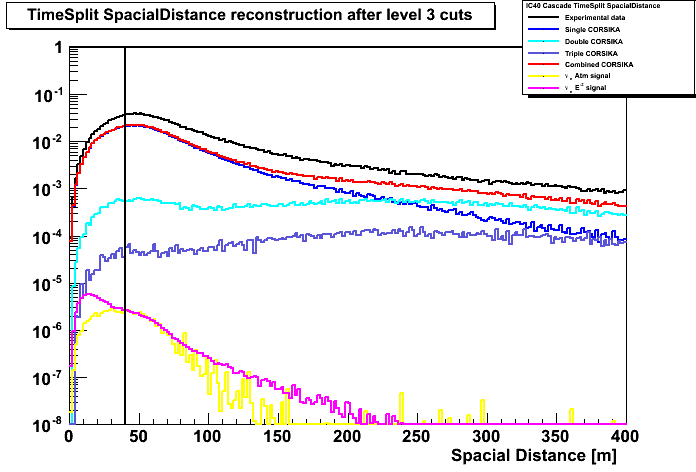
- Spacial Distance: &radic [(SplitSPECascadeLlhVertex2_Pos_X-SplitSPECascadeLlhVertex1_Pos_X)2+(SplitSPECascadeLlhVertex2_Pos_Y-SplitSPECascadeLlhVertex1_Pos_Y)2+(SplitSPECascadeLlhVertex2_Pos_Z-SplitSPECascadeLlhVertex1_Pos_Z)2] < 40 metres
- Fill Ratio From Mean: SDM1_FillRatioFromMean > 0.4
Reconstructions
The level 4 reconstructions for IC40 are as follows:
- CredoFit
This reconstruction is redone at this level of processing with corrected DOMcalibrator settings so that systematics can be determined in the future.
- CredoFit_4iter
Development of cuts
Below are histograms showing cut vaiables for level 4. Experimental data is shown in black. Single muon background CORSIKA is shown in dark blue, double muon background CORSIKA is shown in light blue, combined CORSIKA is shown in red. Atmospheric signal is shown in green and the E-2 signal is shown in pink.
Figure 1 shows the three level 4 cut variables.
 |
 |
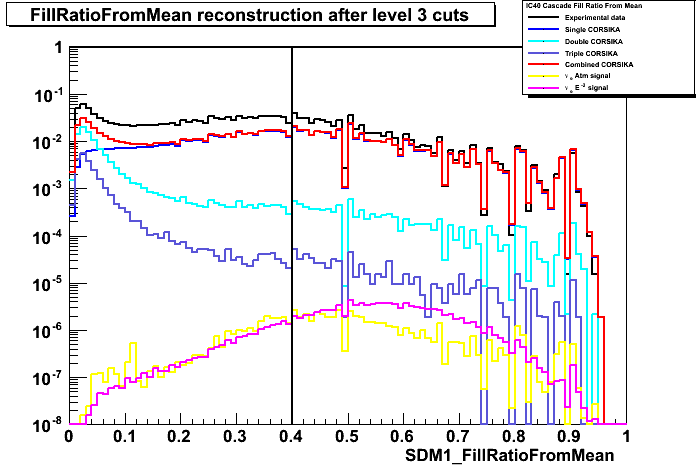 |
Figure 1: Reconstructed energy using credo reconstruction. The energy cut is shown at log10(CredoFit_Energy) > 3.4 in black. Figure 2: Spacial distance between split reconstructions. The cut is shown at &radic[(SplitSPECascadeLlhVertex2_Pos_X-SplitSPECascadeLlhVertex1_Pos_X)2+(SplitSPECascadeLlhVertex2_Pos_Y-SplitSPECascadeLlhVertex1_Pos_Y)2+(SplitSPECascadeLlhVertex2_Pos_Z-SplitSPECascadeLlhVertex1_Pos_Z)2] < 40 metres in black. Figure 3: Fill ratio from mean. The cut is shown at SDM1_FillRatioFromMean > 0.4 in black.
The value of these cuts variables was largely chosen based on maximising signal to background ratio. However, a study was carried out propogating softer cuts through higher level analysis to see how TMVA (level 5) performs when given more signal and background events to train on. The softer cuts were Energy > 3.4, Spacial Distance < 45 m, and Fill Ratio > 0.35. These softer cuts let approximately 5% more signal through. In this case the boosted decision tree in level 5 actually performs worse. This is not a surprising result since the additional signal and background that it receives is lower quality, i.e. the additional signal is more "background" like and the additional background is more "signal" like.
In the first of these figues, the CredoFit_Energy plot, there are two surprising peaks. One is at 0 GeV, and the other is at 6665039062.5 GeV (9.82 on log scale), just below the maximum energy. The first peak disappears when we require the Credo fit to be good (CredoFit_Status==1), indicating that Credo simply fills the first bin when the fit fails. It is interesting to note that Credo fit fails more often when AMANDA is included. The second peak occurs in events where the reconstructed vertex is VERY far from the DOMs that are hit in the event, this can be seen in the event viewer. In this case Credo is returning the energy seeded from AtmCscdEnergyReco. This is due to the hit cleaning and limited range of photonics table (~500 metres). The AtmCscdEnergyReco seed is calculated from cscd-llh vertex reconstruction from level 2b, but we re-run the Feature Extractor at level 3 so AtmCscdEnergy and cscd-llh see different pulsemaps. (cscd-llh ran on time window cleaned and coincified pulses whereas AtmCscdEnergyReco is run on only time window cleaned pulses). The result is that coincident events that are widely separated are hit cleaned differently at level 2b and level 3, and the "other" sub event is chosen so AtmCscdEnergyReco and Credo get a seed that is more than 500 metres away from the hit DOMs. These have no charge prediction from photonics, AtmCscdEnergyReco increases the energy and Credo sticks to this seed. These events then all have an energy of 6665039062.5 GeV and pass the high energy branch filter at level 3. Since these events are so obvious they should be easily filtered out at level 4.
Table 1 shows the passing rates for level 4.
| . | Trigger Rate (Hz) | Level 2 Rate (Hz) | Level 3 Rate (Hz) | Level 4 Rate (Hz) |
| Experimental data | 1500 | 16.38 (1.1%) | 1.75 (10.7%) | 2.54 × 10⁻² (1.5%) |
| Monte Carlo | 1270 | 12.48 (1.0%) | 0.92 (7.4%) | 3.30 × 10⁻² (3.6%) |
| E-2 signal | 2.55 × 10⁻⁴ | 1.48 × 10⁻⁴ (58.0%) | 1.15 × 10⁻⁴ (77.9%) | 5.55 × 10⁻⁵ (48.2%) |
Table 1: Passing rates for level 4.
|